As I show below, I believe Jesus was born 21 August 7 BC as the Urantia Book claims (see text below). I write this to show corroboration from historical writings and artifacts.
Roman Emperor Caesar Augustus ordered a coin struck in 8 BC to commemorate the census he ordered for the purpose of tax collection.
From Augustus' personal written statement of his list of accomplishments, Res Gestae Divi Augusti, or "The Deeds of the Divine Augustus", engraved on the walls of numerous temples like that at Ankara (monumentum Ancyranum):
http://penelope.uchicago.edu/Thayer/E/Roman/Texts/Augustus/Res_Gestae/2*.html
English translation are those of Frederick W. Shipley, as printed in the volume of the Loeb Classical Library, Velleius Paterculus and Res Gestae Divi Augusti, first published in 1924
8 As consul for the fifth time,32 by order of the people and the senate I increased the number of the patricians. Three times I revised the roll of the senate.33 In my sixth consulship, with Marcus Agrippa as my colleague, I made a census of the people.34I performed the lustrum35 after an interval of forty-one years. In this •lustration 4,063,000 Roman citizens were entered on the census roll. A second time,36 in the consulship of Gaius Censorinus and Gaius Asinius, I again performed the lustrum alone, with the consular imperium. In this lustrum 4,233,000 Roman citizens were entered on the census roll. A third time, with the consular imperium, p359and with my son Tiberius Caesar as my colleague, I performed the lustrum in the consulship of Sextus Pompeius and Sextus Apuleius.37 In this lustrum 4,937,000 Roman citizens were entered on the census roll. By the passage of new laws I restored many traditions of our ancestors which were then falling into disuse, and I myself set precedents in many things for posterity to imitate.38
The lustrum is a purification ritual for the people every 5 years after a census. Augustus ordered a census in 28 B.C., 8 B.C., and 14 A.D. Footnote 36 shows the second one at 8 B.C., the year preceding Jesus' birth. And notice that August explains that he performed the third with his son Tiberias during the two and a half years when they jointly ruled the Roman Empire at the end of Augustus' life.
This coin (below), struck in 8 B.C., shows an Augustus bust on one side and Gaius [Octavius] Caesar (Augustus) on horseback on the obverse side. Notice the items at the top of the center legionary standard on the far side of the horse's rear haunch. The inscription from the experts identifies it as an eagle. To me it looks like barley ears above an object that might be an eagle. Perhaps those barley ears symbolize the medium of taxation, crops and other food.
This site shows images of many coins struck during the rein of Augustus, including the coins shown below:
http://www.flickr.com/groups/2155749@N22/
The specific coin of interest also appears here, with descriptive text and images as shown:
http://www.wildwinds.com/coins/ric/augustus/i.html

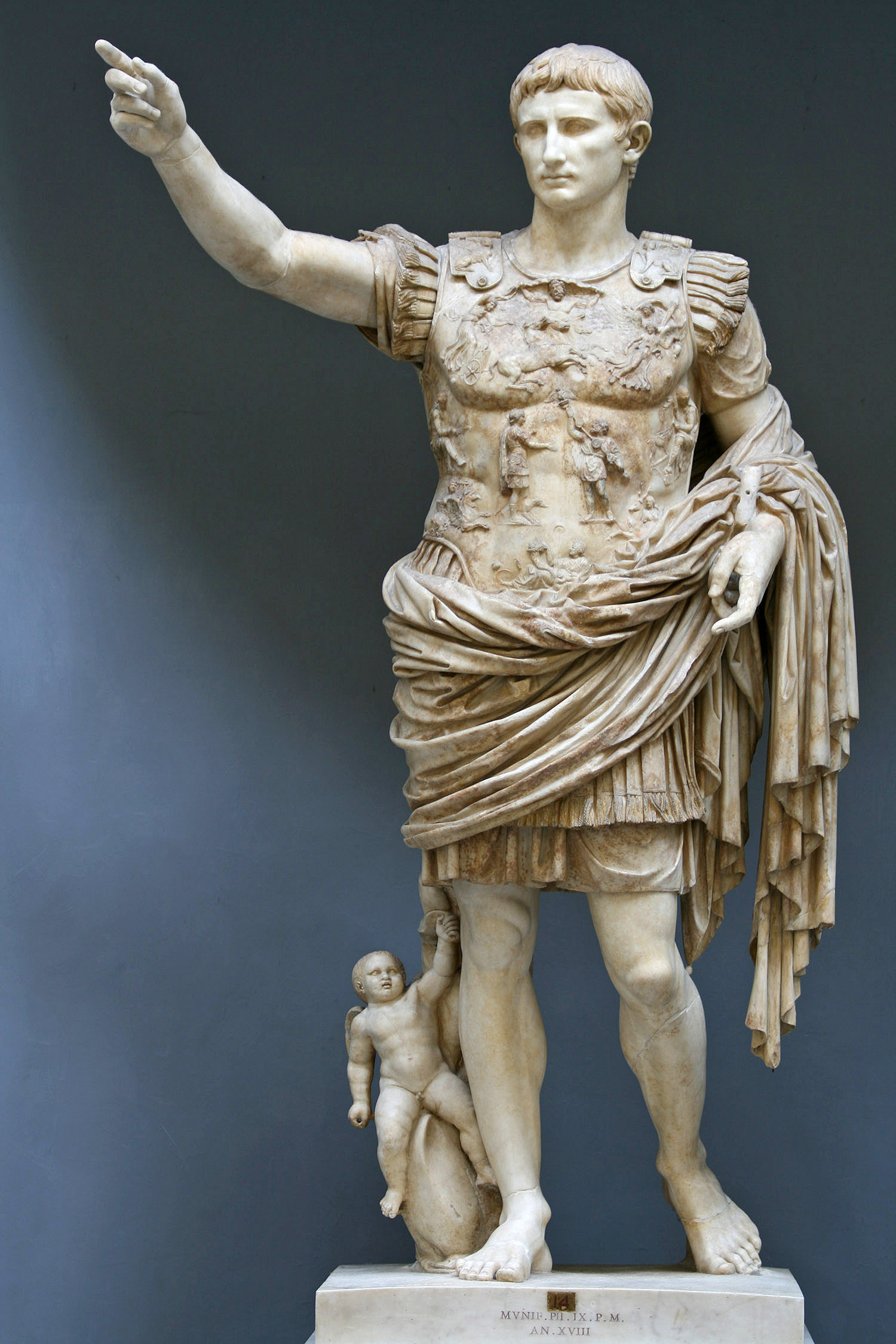
The text above refers to an eagle on the center pike. If that splotch on the pike is an eagle, then it is not at the top of the pike. As I said, the item at the top looks like ears of barley to me. The breastplate carved into a marble statue of Augustus from Livia'a villa a Prima Porta shows the Parthian king returning to Augustus a war prize, a Roman legionary standard captured in battle, having an eagle at the top, the most typical location.
From the Bible, Luke 2:1
"And it came to pass in those days, that there went out a decree from Caesar Augustus, that all the world should be registered."
Rome, Herod, and politics around the time of Jesus's Birth
--> (1334.1) 121:2.7 The Jewish people of this time, although under Roman suzerainty, enjoyed a considerable degree of self-government and, remembering the then only recent heroic exploits of deliverance executed by Judas Maccabee and his immediate successors, were vibrant with the expectation of the immediate appearance of a still greater deliverer, the long-expected Messiah.Roman Emperor Caesar Augustus ordered a coin struck in 8 BC to commemorate the census he ordered for the purpose of tax collection.
From Augustus' personal written statement of his list of accomplishments, Res Gestae Divi Augusti, or "The Deeds of the Divine Augustus", engraved on the walls of numerous temples like that at Ankara (monumentum Ancyranum):
http://penelope.uchicago.edu/Thayer/E/Roman/Texts/Augustus/Res_Gestae/2*.html
English translation are those of Frederick W. Shipley, as printed in the volume of the Loeb Classical Library, Velleius Paterculus and Res Gestae Divi Augusti, first published in 1924
8 As consul for the fifth time,32 by order of the people and the senate I increased the number of the patricians. Three times I revised the roll of the senate.33 In my sixth consulship, with Marcus Agrippa as my colleague, I made a census of the people.34I performed the lustrum35 after an interval of forty-one years. In this •lustration 4,063,000 Roman citizens were entered on the census roll. A second time,36 in the consulship of Gaius Censorinus and Gaius Asinius, I again performed the lustrum alone, with the consular imperium. In this lustrum 4,233,000 Roman citizens were entered on the census roll. A third time, with the consular imperium, p359and with my son Tiberius Caesar as my colleague, I performed the lustrum in the consulship of Sextus Pompeius and Sextus Apuleius.37 In this lustrum 4,937,000 Roman citizens were entered on the census roll. By the passage of new laws I restored many traditions of our ancestors which were then falling into disuse, and I myself set precedents in many things for posterity to imitate.38
The lustrum is a purification ritual for the people every 5 years after a census. Augustus ordered a census in 28 B.C., 8 B.C., and 14 A.D. Footnote 36 shows the second one at 8 B.C., the year preceding Jesus' birth. And notice that August explains that he performed the third with his son Tiberias during the two and a half years when they jointly ruled the Roman Empire at the end of Augustus' life.
This coin (below), struck in 8 B.C., shows an Augustus bust on one side and Gaius [Octavius] Caesar (Augustus) on horseback on the obverse side. Notice the items at the top of the center legionary standard on the far side of the horse's rear haunch. The inscription from the experts identifies it as an eagle. To me it looks like barley ears above an object that might be an eagle. Perhaps those barley ears symbolize the medium of taxation, crops and other food.
This site shows images of many coins struck during the rein of Augustus, including the coins shown below:
http://www.flickr.com/groups/2155749@N22/
The specific coin of interest also appears here, with descriptive text and images as shown:
http://www.wildwinds.com/coins/ric/augustus/i.html
| RIC 198 | Augustus AV Aureus. Lyons mint, 9-8 BC. AVGVSTVS DIVI F, laureate head right / C CAES, Caius Caesar galloping right, eagle between two standards behind, AVGVS F in ex. Cohen 39. | Text | Image |
| Text | Image |

Freeman & Sear - Mail Bid Sale 14 Lot: 388 ROMAN EMPIRE: Augustus. (27 BC–AD 14). AV aureus. ROMAN EMPIRE. Augustus (27 BC–AD 14). AV aureus (7.67 gm). Lugdunum, 8 BC. AVGVSTVS DIVI. F, laureate head of Augustus right / C. CAES AVGVS. F, Gaius Caesar on horse leaping right, three standards in background. RIC 198. BMCRE 498. CBN 1468. RCTV 1596. Some edge filing and damage on reverse edge at 7:30. Fine/nearly very fine Estimated Value: $ 750 ... Lot 388 sold for high bid of $1350 [ $1552.5, or approx 1148.85 EUR, 776.25 GBP including the 15% buyers fee.] Freeman & Sear Mail Bid Sale 14 closed June 21st, 2007. Re-used by permission of Freeman & Sear: www.freemanandsear.comFreeman & Sear - F&S Mail Bid Sale #11 ancient classic artifacts coins numismatic roman greek Show F&S Mail Bid Sale #11 Lots Enter Search Term (i.e. Keywords, Catalog ID, etc.) Lot: 287 (click on image to enlarge) KRH011 ROMAN EMPIRE: Augustus. 27 BC-AD 14. AV aureus (7.90 gm). ROMAN EMPIRE: Augustus (27 BC-AD 14). AV aureus (7.90 gm), Lugdunum, 8-7 BC. Laureate head of Augustus right / C. CAES above, AVGVS. F below, C. Caesar on horseback galloping right, holding sword and round shield, aquila between two standards behind. RIC 198, pl. 4. BMCRE 498, pl. 12, 15. C. 39. An unusually well-centered specimen. A few edge marks. Good very fine Estimated Value: $ 5,500 Lot sold for $4,875, [ approx 3656.25 EUR, 2535 GBP ] plus 15% buyers fee. Re-used by permission of Freeman and Sear, www.freemanandsear.com.

The text above refers to an eagle on the center pike. If that splotch on the pike is an eagle, then it is not at the top of the pike. As I said, the item at the top looks like ears of barley to me. The breastplate carved into a marble statue of Augustus from Livia'a villa a Prima Porta shows the Parthian king returning to Augustus a war prize, a Roman legionary standard captured in battle, having an eagle at the top, the most typical location.


*********************************************
That particular coin seems to corroborate explanations in The Urantia Book. See the excerpts below.
From the Bible, Luke 2:1
"And it came to pass in those days, that there went out a decree from Caesar Augustus, that all the world should be registered."
The Urantia Book
Paper 121
Rome, Herod, and politics around the time of Jesus's Birth
(1334.2) 121:2.8 The secret of the survival of Palestine, the kingdom of the Jews, as a semi-independent state was wrapped up in the foreign policy of the Roman government, which desired to maintain control of the Palestinian highway of travel between Syria and Egypt as well as the western terminals of the caravan routes between the Orient and the Occident. Rome did not wish any power to arise in the Levant which might curb her future expansion in these regions. The policy of intrigue which had for its object the pitting of Seleucid Syria and Ptolemaic Egypt against each other necessitated fostering Palestine as a separate and independent state. Roman policy, the degeneration of Egypt, and the progressive weakening of the Seleucids before the rising power of Parthia, explain why it was that for several generations a small and unpowerful group of Jews was able to maintain its independence against both Seleucidae to the north and Ptolemies to the south. This fortuitous liberty and independence of the political rule of surrounding and more powerful peoples the Jews attributed to the fact that they were the “chosen people,” to the direct interposition of Yahweh. Such an attitude of racial superiority made it all the harder for them to endure Roman suzerainty when it finally fell upon their land. But even in that sad hour the Jews refused to learn that their world mission was spiritual, not political.
(1334.3) 121:2.9 The Jews were unusually apprehensive and suspicious during the times of Jesus because they were then ruled by an outsider, Herod the Idumean, who had seized the overlordship of Judea by cleverly ingratiating himself with the Roman rulers. And though Herod professed loyalty to the Hebrew ceremonial observances, he proceeded to build temples for many strange gods.
(1334.4) 121:2.10 The friendly relations of Herod with the Roman rulers made the world safe for Jewish travel and thus opened the way for increased Jewish penetration even of distant portions of the Roman Empire and of foreign treaty nations with the new gospel of the kingdom of heaven. Herod’s reign also contributed much toward the further blending of Hebrew and Hellenistic philosophies.
(1334.5) 121:2.11 Herod built the harbor of Caesarea, which further aided in making Palestine the crossroads of the civilized world. He died in 4 B.C., and his son Herod Antipas governed Galilee and Perea during Jesus’ youth and ministry to A.D. 39. Antipas, like his father, was a great builder. He rebuilt many of the cities of Galilee, including the important trade center of Sepphoris.
(1334.6) 121:2.12 The Galileans were not regarded with full favor by the Jerusalem religious leaders and rabbinical teachers. Galilee was more gentile than Jewish when Jesus was born.
From Paper 122
Rome's census and taxation, the delay by Herod, and the birth of Jesus of Nazareth.
(1350.3) 122:7.1 In the month of March, 8 B.C. (the month Joseph and Mary were married), Caesar Augustus decreed that all inhabitants of the Roman Empire should be numbered, that a census should be made which could be used for effecting better taxation. The Jews had always been greatly prejudiced against any attempt to “number the people,” and this, in connection with the serious domestic difficulties of Herod, King of Judea, had conspired to cause the postponement of the taking of this census in the Jewish kingdom for one year. Throughout all the Roman Empire this census was registered in the year 8 B.C., except in the Palestinian kingdom of Herod, where it was taken in 7 B.C., one year later.
--> (1351.5) 122:8.1 All that night Mary was restless so that neither of them slept much. By the break of day the pangs of childbirth were well in evidence, and at noon, August 21, 7 B.C., with the help and kind ministrations of women fellow travelers, Mary was delivered of a male child. Jesus of Nazareth was born into the world, was wrapped in the clothes which Mary had brought along for such a possible contingency, and laid in a near-by manger.
(1351.6) 122:8.2 In just the same manner as all babies before that day and since have come into the world, the promised child was born; and on the eighth day, according to the Jewish practice, he was circumcised and formally named Joshua (Jesus).
(1351.7) 122:8.3 The next day after the birth of Jesus, Joseph made his enrollment. Meeting a man they had talked with two nights previously at Jericho, Joseph was taken by him to a well-to-do friend who had a room at the inn, and who said he would gladly exchange quarters with the Nazareth couple. That afternoon they moved up to the inn, where they lived for almost three weeks until they found lodgings in the home of a distant relative of Joseph.
(1351.8) 122:8.4 The second day after the birth of Jesus, Mary sent word to Elizabeth that her child had come and received word in return inviting Joseph up to Jerusalem to talk over all their affairs with Zacharias. The following week Joseph went to Jerusalem to confer with Zacharias. Both Zacharias and Elizabeth had become possessed with the sincere conviction that Jesus was indeed to become the Jewish deliverer, the Messiah, and that their son John was to be his chief of aides, his right-hand man of destiny. And since Mary held these same ideas, it was not difficult to prevail upon Joseph to remain in Bethlehem, the City of David, so that Jesus might grow up to become the successor of David on the throne of all Israel. Accordingly, they remained in Bethlehem more than a year, Joseph meantime working some at his carpenter’s trade.
(1352.1) 122:8.5 At the noontide birth of Jesus the seraphim of Urantia, assembled under their directors, did sing anthems of glory over the Bethlehem manger, but these utterances of praise were not heard by human ears. No shepherds nor any other mortal creatures came to pay homage to the babe of Bethlehem until the day of the arrival of certain priests from Ur, who were sent down from Jerusalem by Zacharias.
(1352.2) 122:8.6 These priests from Mesopotamia had been told sometime before by a strange religious teacher of their country that he had had a dream in which he was informed that “the light of life” was about to appear on earth as a babe and among the Jews. And thither went these three teachers looking for this “light of life.” After many weeks of futile search in Jerusalem, they were about to return to Ur when Zacharias met them and disclosed his belief that Jesus was the object of their quest and sent them on to Bethlehem, where they found the babe and left their gifts with Mary, his earth mother. The babe was almost three weeks old at the time of their visit.
(1352.3) 122:8.7 These wise men saw no star to guide them to Bethlehem. The beautiful legend of the star of Bethlehem originated in this way: Jesus was born August 21 at noon, 7 B.C. On May 29, 7 B.C., there occurred an extraordinary conjunction of Jupiter and Saturn in the constellation of Pisces. And it is a remarkable astronomic fact that similar conjunctions occurred on September 29 and December 5 of the same year. Upon the basis of these extraordinary but wholly natural events the well-meaning zealots of the succeeding generation constructed the appealing legend of the star of Bethlehem and the adoring Magi led thereby to the manger, where they beheld and worshiped the newborn babe. Oriental and near-Oriental minds delight in fairy stories, and they are continually spinning such beautiful myths about the lives of their religious leaders and political heroes. In the absence of printing, when most human knowledge was passed by word of mouth from one generation to another, it was very easy for myths to become traditions and for traditions eventually to become accepted as facts.
Paper 174
The Right to Mint Coins and the Right to Levy Taxes
--> (1899.2) 174:2.2 Tuesday morning, when Jesus arrived in the temple court and began to teach, he had uttered but few words when a group of the younger students from the academies, who had been rehearsed for this purpose, came forward and by their spokesman addressed Jesus: “Master, we know you are a righteous teacher, and we know that you proclaim the ways of truth, and that you serve only God, for you fear no man, and that you are no respecter of persons. We are only students, and we would know the truth about a matter which troubles us; our difficulty is this: Is it lawful for us to give tribute to Caesar? Shall we give or shall we not give?” Jesus, perceiving their hypocrisy and craftiness, said to them: “Why do you thus come to tempt me? Show me the tribute money, and I will answer you.” And when they handed him a denarius, he looked at it and said, “Whose image and superscription does this coin bear?” And when they answered him, “Caesar’s,” Jesus said, “Render to Caesar the things that are Caesar’s and render to God the things that are God’s.”
(1899.3) 174:2.3 When he had thus answered these young scribes and their Herodian accomplices, they withdrew from his presence, and the people, even the Sadducees, enjoyed their discomfiture. Even the youths who had endeavored to entrap him marveled greatly at the unexpected sagacity of the Master’s answer.
(1899.4) 174:2.4 The previous day the rulers had sought to trip him before the multitude on matters of ecclesiastical authority, and having failed, they now sought to involve him in a damaging discussion of civil authority. Both Pilate and Herod were in Jerusalem at this time, and Jesus’ enemies conjectured that, if he would dare to advise against the payment of tribute to Caesar, they could go at once before the Roman authorities and charge him with sedition. On the other hand, if he should advise the payment of tribute in so many words, they rightly calculated that such a pronouncement would greatly wound the national pride of his Jewish hearers, thereby alienating the good will and affection of the multitude.
(1899.5) 174:2.5 In all this the enemies of Jesus were defeated since it was a well-known ruling of the Sanhedrin, made for the guidance of the Jews dispersed among the gentile nations, that the “right of coinage carried with it the right to levy taxes.” In this manner Jesus avoided their trap. To have answered “No” to their question would have been equivalent to inciting rebellion; to have answered “Yes” would have shocked the deep-rooted nationalist sentiments of that day. The Master did not evade the question; he merely employed the wisdom of making a double reply. Jesus was never evasive, but he was always wise in his dealings with those who sought to harass and destroy him.
Papers 135 and 136
Regarding Jesus' age at baptism.
-->
--> (1504.3) 135:8.5 Being engrossed with the details of rapidly baptizing such a large number of converts, John did not look up to see Jesus until the Son of Man stood in his immediate presence. When John recognized Jesus, the ceremonies were halted for a moment while he greeted his cousin in the flesh and asked, “But why do you come down into the water to greet me?” And Jesus answered, “To be subject to your baptism.” John replied: “But I have need to be baptized by you. Why do you come to me?” And Jesus whispered to John: “Bear with me now, for it becomes us to set this example for my brothers standing here with me, and that the people may know that my hour has come.”
(1504.4) 135:8.6 There was a tone of finality and authority in Jesus’ voice. John was atremble with emotion as he made ready to baptize Jesus of Nazareth in the Jordan at noon on Monday, January 14, A.D. 26. Thus did John baptize Jesus and his two brothers James and Jude. And when John had baptized these three, he dismissed the others for the day, announcing that he would resume baptisms at noon the next day. As the people were departing, the four men still standing in the water heard a strange sound, and presently there appeared for a moment an apparition immediately over the head of Jesus, and they heard a voice saying, “This is my beloved Son in whom I am well pleased.” A great change came over the countenance of Jesus, and coming up out of the water in silence he took leave of them, going toward the hills to the east. And no man saw Jesus again for forty days.
(1512.4) 136:2.8 (Jesus was almost thirty-one and one-half years old when he was baptized. While Luke says that Jesus was baptized in the fifteenth year of the reign of Tiberius Caesar, which would be A.D. 29 since Augustus died in A.D. 14, it should be recalled that Tiberius was coemperor with Augustus for two and one-half years before the death of Augustus, having had coins struck in his honor in October, A.D. 11. The fifteenth year of his actual rule was, therefore, this very year of A.D. 26, that of Jesus’ baptism. And this was also the year that Pontius Pilate began his rule as governor of Judea.)
****************** End of Urantia Book excerpts *********************
This coin shows Augustus on one side and Tiberias on the other, signifying the period of their joint rule.
Augustus & Tiberius Denarius. Lugdunum mint, 13-14 AD. CAESAR AVGVSTVS DIVI F PATER PATRIAE, laureate head right / TI CAESAR AVG F TR POT XV, bare head of Tiberius right. RSC 2.


Augustus Denarius. Lugdunum mint, 13 AD. CAESAR AVGVSTVS DIVI F PATER PATRIAE, laureate head right / TI CAESAR AVG F TR POT XV, Tiberius standing right in triumphal quadriga, holding eagle tipped sceptre. RSC 301.
Another, from 13 AD honoring Augustus and Tiberias jointly
Augustus AV Aureus. Rome mint, 13-14 AD. CAESAR AVGVSTVS DIVI F PATER PATRIAE, laureate head right / AVG F TR POT XV, TI CAESAR below, Tiberius riding quadriga right, holding eagle tipped sceptre. Cohen 299.http://www.wildwinds.com/coins/ric/augustus/RIC_0221.jpg

http://penelope.uchicago.edu/Thayer/E/Roman/Texts/Suetonius/12Caesars/Tiberius*.html#21
Suetonius, The Lives of Twelve Caesars, Life of Tiberius
"211 Since the consuls caused a law to be passed soon after this that he should govern the provinces jointly with Augustus and hold the census with him, he set out for Illyricum on the conclusion of the lustral ceremonies; but he was at once recalled, and finding Augustus in his last illness but still alive, he spent an entire day with him in private."

Seutonius was a Roman historian born in 69 A.D.
-->
 |  |
Bob Hurt sent this information to me:"The Urantia Book establishes Jesus' birth at noon 21August 7 BCE, the year Herod implemented Augustus'census for taxation purposes. Herod convinced Augustusto delay the census a year in order to settle Jewish unrestover being numbered. History corroborates it becauseAugustus ordered coins struck in 8 BCE to commemoratethe event. The tax authorities collected taxes after thesummer harvest, and that occasioned Joseph to travel tohis home town in late August for registration."Jerry adds:Herod died three years later, in the year 4 BCE. At theend of Herod’s reign, anger and dissatisfaction was acommon feeling amongst the Jews. Heavy violence suchas riots occurred following Herod’s death in many cities,one being Jerusalem. All the grievances Jews had towardHerod caused during his reign such as heavy taxes andrule breakage were built up until now. Because of thetreatment the Jews were receiving at the time, they wereready to break free from Roman Rule. Herod’s leadershipsparked such anger and revolt that it eventually led to beone of that causes of the Great Revolt of 70 C.E. He wasknown for his colossal building projects throughout Judea,including his expansion of the Second Temple in Jerusalem(Herod's Temple), the construction of the port at CaesareaMaritima, the fortress at Masada and Herodium. Vitaldetails of his life are recorded in the works of the 1stcentury CE Roman–Jewish historian Josephus. UponHerod's death, the Romans divided his kingdom amongthree of his sons—Archelaus became ethnarch of thetetrarchy of Judea, Herod Antipas became tetrarch ofGalilee and Peraea, and Philip became tetrarch ofterritories east of the Jordan.More online info for research on the many Herods:
Herod is a name used of several kings belonging to the Herodian Dynasty of the Roman province of Judaea:
- Herod the Great (c. 74–4 BCE), client king of Judaea who rebuilt the Second Temple (in Jerusalem) into Herod's Temple
- Herod Archelaus (23 BC–c. AD 18), ethnarch of Samaria, Judea, and Idumea
- Herod Antipas (20 BC–c. AD 40), tetrarch of Galilee and Peraea, called "Herod the Tetrarch" or "Herod" in the New Testament up to Acts 4:27, and described therein as ordering John the Baptist's death and as mocking Jesus
- Herod II (c. 27 BC–33 AD), sometimes called Herod Philip I, father of Salome
- Philip the Tetrarch (4 BC–AD 34), sometimes called Herod Philip II, tetrarch of Ituraea and Trachonitis
- Herod Agrippa I (c. 10 BC–AD 44), client king of Judaea, called "King Herod" or "Herod" in Acts 12 of the New Testament
- Herod of Chalcis, also known as Herod III, king of Chalcis (AD 41–48)
- Herod Agrippa II (AD 27–100), tetrarch of Chalcis who was described in Acts of the Apostles as "King Agrippa" before whom Paul of Tarsus defended himself
- Herodes Atticus (AD 101–177), an unrelated Greek aristocrat who served as a Roman Senator and proponent of Sophism
-------------------------------------------------------------------------------------Jerry Wayne Bernard, Director, Author, and Musician
Library in the Palms Research Center on Tongva Peak
2328 Via Saldivar Street, Glendale, CA 91208-1953
--------
To receive all the material in the Gospel of John study...
Go to...
http://www.jerrybernard.com/BooksByJWB.htm